What Are Discount Coupons and How Do They Work?
Posted on |
What Are Discount Coupons and How Do They Work for Users and Stores?
The Revolution of Savings in E-commerce
In a rapidly evolving e-commerce landscape, discount coupons have become an indispensable tool for both consumers and businesses. Who doesn’t enjoy getting a great deal or saving some money when purchasing their favorite products? These seemingly simple magical codes hold immense economic and marketing power, capable of transforming an ordinary shopping experience into an adventure filled with opportunities and savings. But, what are discount coupons and how do they work for users and stores? This is the question we will answer in detail in this comprehensive article, exploring the depths of this digital phenomenon that has reshaped modern commerce.
What Are Discount Coupons?
Discount coupons, also known as promo codes, voucher codes, or promotional codes, are essentially a marketing tool offered by stores (both online and traditional) to their customers to incentivize purchases. These coupons usually come in the form of an alphanumeric code that can be entered during checkout to receive a specific reduction on the total price of products or services, or to gain an additional benefit such as free shipping. They serve as a direct incentive for consumers, enticing them to complete a purchase and take advantage of the offer, while simultaneously being an effective strategy for stores to increase sales and attract new customers .
How Do Discount Coupons Work? The Journey from Store to Customer
To fully understand how discount coupons work, we must examine them from two main perspectives: the store offering the coupon, and the user benefiting from it.
How It Works from the E-commerce Store’s Perspective
For stores, the process of creating discount coupons begins with defining marketing objectives. Is the goal to boost sales for a specific product? Attract new customers? Reward loyal customers? Or clear excess inventory? Based on these objectives, the store creates the coupon and sets its terms and conditions, which include:
•Discount Value: This can be a percentage (e.g., 10% off), a fixed amount (e.g., $50 off), or free shipping.
•Targeted Products or Categories: Does the discount apply to all products or only a specific category?
•Minimum Purchase Requirement: Does the coupon require a minimum spending amount to be eligible?
•Validity Period: When does the coupon start and when does it expire?
•Usage Limit: Can the coupon be used once per customer, or multiple times?
•Target Audience: Is the coupon available to everyone, only new customers, or specific existing customers?
After defining these conditions, a unique coupon code is generated and distributed through various marketing channels such as email, social media, advertisements, or coupon websites. The e-commerce system tracks the usage of these coupons and automatically applies the discount when the correct code is entered by the customer.
How It Works from the Shopper’s (User’s) Perspective
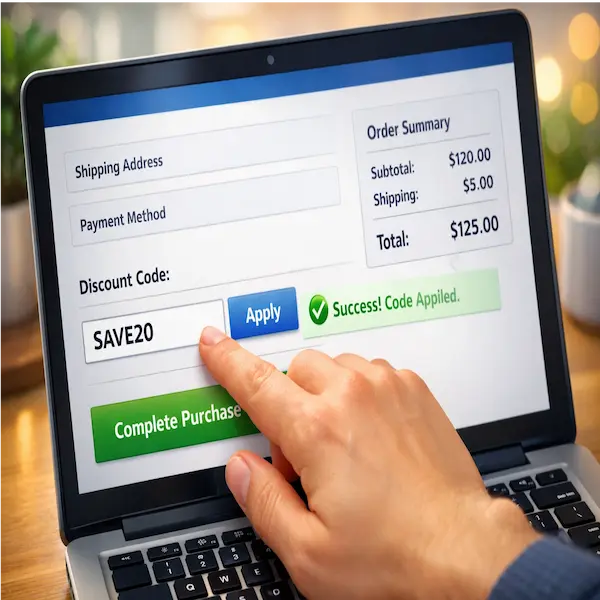
For the shopper, the journey begins by searching for suitable voucher codes or promo codes. This can be done by receiving emails from favorite stores, following store pages on social media, or visiting specialized coupon aggregation websites. Once the right coupon is found, the user copies the code. During the checkout process on the e-commerce store, the user typically finds a dedicated field to enter the promotional code or discount code on the payment page. After entering the code and clicking the apply button, the system verifies the coupon’s validity and conditions. If the conditions are met, the discount is applied directly to the total invoice amount, showing the final reduced price .
Most Common Types of Discount Coupons
Discount coupons vary to suit different marketing strategies and meet diverse customer needs. Here are their main types:
Percentage-Based Coupons (%)
This is the most common type, offering a percentage discount on the total purchase value. For example,
“15% off all products” or “20% off your first order.” This type is effective in stimulating sales growth, especially for larger purchases.
Fixed Amount Coupons (Direct Cash Discount)
These coupons offer a fixed monetary discount from the total bill, such as “$50 off your purchase.” These coupons are attractive to consumers because they see the savings value directly and clearly.
Free Shipping Coupons
Shipping costs are one of the biggest barriers to completing online purchases. Therefore, free shipping coupons are very effective in reducing shopping cart abandonment rates and encouraging customers to finalize their orders, especially for orders that do not exceed a certain limit.
“Buy One Get One Free” (BOGO) Coupons
These coupons are abbreviated as BOGO. They allow customers to get a free product when they buy another, or to get a significant discount on the second product. This strategy is excellent for promoting new products or clearing stagnant inventory.
New Customer and Loyalty Coupons
These coupons target specific customer segments. New customer coupons aim to attract new users and encourage them to make their first purchase. Loyalty coupons, on the other hand, aim to reward existing customers and foster customer loyalty, making them feel appreciated and increasing the likelihood of their returning for future purchases. This in turn reduces the cost of acquiring new customers and increases the customer lifetime value (LTV).
Benefits of Discount Coupons for E-commerce Stores
The benefits of discount coupons are not limited to consumers; they also represent a powerful marketing tool for e-commerce stores, contributing to the achievement of several strategic objectives:
Increasing Sales Volume and Converting Visitors into Customers
Coupons are a strong motivator that prompts hesitant visitors to make a purchase decision. Attractive offers encourage them to try products or services, leading to increased sales and converting visitors into actual customers. They also help attract new customers who might not have considered purchasing otherwise .
Clearing Stagnant Inventory
Coupons are an effective way for stores to clear out products that haven’t sold well or are nearing their expiration date. By offering attractive discounts on these items, stores can convert stagnant inventory into cash flow and make space for new products.
Enhancing Customer Loyalty and Retention
When customers feel that a store values them and offers them special deals, their customer loyalty to the store increases. Coupons specifically designed for loyal customers or those offering exclusive benefits encourage them to return for repeat purchases, contributing to building a long-term relationship. This, in turn, reduces the cost of new customer acquisition and increases the customer lifetime value (LTV).
Benefits of Discount Coupons for Users (Smart Shoppers)
For consumers, discount coupons are a real treasure, offering multiple advantages that make the shopping experience more enjoyable and economical:
Saving Money and Reducing Costs
The most obvious benefit of discount coupons is saving money. Getting a discount on product prices means paying less for the same item, which helps reduce overall shopping costs and allows consumers to buy more with the same budget, or save the difference for other purposes.
Trying New Products at Reduced Prices
Coupons encourage consumers to try new products or services they might not have considered buying at full price. With a discount, the risk is lower, opening the door to discovering new products that might become their favorites. Studies have shown that approximately 60% of consumers try new products because of discount coupons .

Golden Tips for Smart Use of Discount Coupons
To maximize the benefits of discount coupons, whether you are a shopper or a store owner, here are some golden tips:
•For Shoppers:
•Search Smartly: Don’t just rely on coupons you receive; actively search for them on specialized coupon websites and deal forums.
•Read Terms and Conditions: Make sure you understand the coupon’s terms, such as validity date, minimum purchase, and excluded products.
•Compare Prices: Don’t assume a coupon guarantees the best price. Compare the price after discount with other stores.
•Don’t Buy What You Don’t Need: Don’t let the allure of a discount push you to buy products you don’t need.
•For Stores:
•Clearly Define Your Goals: Before launching any coupon campaign, determine what you aim to achieve.
•Target the Right Audience: Design your coupons to suit specific customer segments (new, loyal, etc.).
•Track Performance: Monitor the performance of your coupons to identify the most effective ones and refine your strategies.
•Make Terms Clear: Avoid any ambiguity in coupon terms to prevent customer frustration.
Frequently Asked Questions About Discount Coupons (FAQ)
Q1: What is the difference between a discount coupon and a promo code?
A1: There is no fundamental difference; both refer to the same concept: an alphanumeric code used to get a discount or an additional benefit upon purchase. The terminology may vary from one store to another.
Q2: Can I use more than one discount coupon in a single purchase?
A2: In most cases, stores allow only one discount coupon per purchase. However, some stores may permit combining coupons in special offers, so you should check the terms and conditions for each coupon.
Q3: What should I do if my discount coupon doesn’t work?
A3: First, ensure you have entered the code correctly, and check the coupon’s validity date, minimum purchase requirement, and applicable products. If the problem persists, contact the store’s customer service.
Q4: Do discount coupons affect product quality?
A4: No, discount coupons do not affect product quality. They are a marketing tool to increase sales or attract customers and have no bearing on the quality of goods sold.
Q5: How can I find the best discount coupons?
A5: You can find the best discount coupons by subscribing to your favorite stores’ newsletters, following their social media accounts, and visiting specialized coupon websites that aggregate the latest offers.
Conclusion
In conclusion, it is clear that discount coupons are not just random numbers and letters; they are an integral part of modern marketing strategies and a key to saving money for consumers. They create a mutually beneficial relationship, where shoppers benefit from better prices, and stores benefit from increased sales and customer loyalty. Therefore, whether you are a shopper looking for the best deals or a store owner seeking to boost your business, understanding and smartly utilizing discount coupons is a fundamental step towards success in the growing e-commerce world.
Don’t miss out on savings! Start now by searching for available discount coupons for your favorite products, or if you are a store owner, consider launching your own coupon campaign to see how this simple tool can transform your business into a resounding success!